
Is Your Child Struggling with Poor Posture, Swallowing, or Bowel/Bladder Issues?
Believe it or not, these challenges can all be connected through one key concept: breathing.
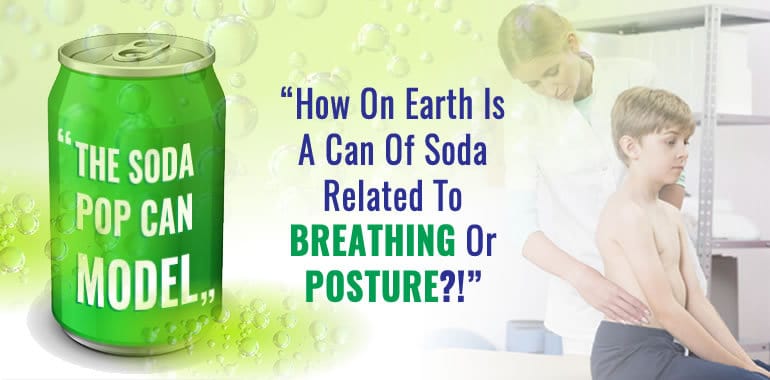
You might be wondering, “What does a soda can have to do with breathing or posture?!” Honestly, I was curious too until I took a course recently led by Mary Massery—a pioneering physical therapist who developed a model that explains this beautifully. (And yes, I was totally starstruck—nerd alert!)
It’s called “The Soda Can Model.” Think about a can of soda: when it’s closed and full, you can’t crush it. But once it’s open, it’s easy to crush. The strength of the can isn’t from the aluminum itself—it comes from the pressure inside.
So, what gives the can its strength?
Pressure. When sealed, the pressure inside the can is higher than the outside air, which keeps it rigid.
Now, Massery compares our trunk to this soda can. Imagine your head is at the top of the can, your diaphragm in the middle, and your feet at the bottom. The diaphragm isn’t just for breathing—it plays a crucial role in posture! Above the diaphragm are your lungs, chest, and vocal folds. Below are your abdomen and pelvic floor. All these parts create different pressures in your body’s “cavities,” which constantly shift as you breathe.
Back to the can—if it’s open, you can crush it. Why? Because the internal pressure is lost, and the structure weakens. The same thing happens in our bodies. If the “top of your can”—that’s your vocal folds—is weak, your posture and strength suffer. Does your child have trouble swallowing or feeding? That could be a sign of a weak “top of the can,” making breath-swallow coordination difficult. On the flip side, a weak “bottom of the can”—the pelvic floor—can lead to challenges with gut motility and postural control.
Everything hinges on the pressures regulated by the diaphragm. To maintain posture and control of the trunk, internal pressures must be greater than the outside forces (like gravity)—just like the soda can! If a child struggles to manage this, they’ll find sitting upright and breathing harder than expected.
Surprised to learn that posture and breathing are so closely linked? The great news is that with targeted exercises and techniques, you can improve both! Good posture doesn’t just help with standing or sitting—it also impacts feeding, breathing, and toileting. Strong posture and breathing reduce risks of complications like scoliosis and aspiration.
So, keep those cans full—help your loved one build and maintain the pressures that support their strength and function!

Christine Astarita
She discovered her passion for the neurologic pediatric and adult population during her clinical affiliation at a special services school in Cape May, New Jersey. She is an active member of the APTA and continues to take post-graduate course work related to treatment methods for neurological diagnoses.